Bridge or Tunnel? Crossing Between Asia and Europe in Istanbul
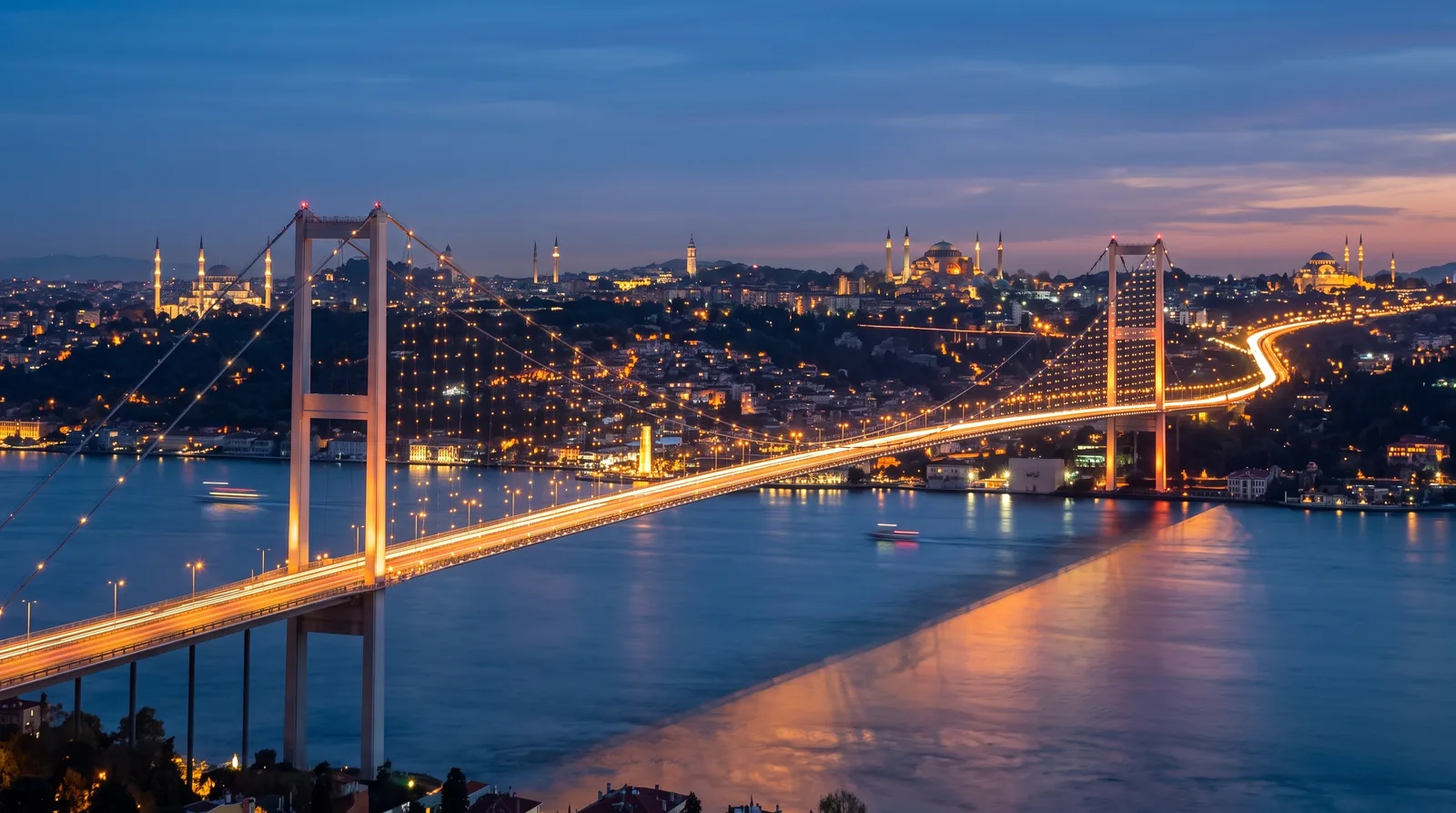
What makes Istanbul unlike any other big city is that it spans two continents. Crossing from the Asian side to the European side, or the other way round, is part of countless everyday journeys. If you land at Sabiha Gökçen and your hotel is in Europe, or you land at Istanbul Airport and are heading to the Asian side, this crossing is the part of the trip that matters most. By road, there are four ways across the Bosphorus: the Eurasia Tunnel, the 15 July Martyrs Bridge, the Fatih Sultan Mehmet Bridge and the Yavuz Sultan Selim Bridge. Here is where each one is, which neighborhoods it suits, and when it makes sense.
Four crossings, four personalities
Eurasia Tunnel
The Eurasia Tunnel is a two-level road tunnel running beneath the Bosphorus. It surfaces at Kazlıçeşme on the European side and at Göztepe on the Asian side. Because its European exit feeds straight onto the coastal road, it is a natural choice for Sultanahmet, Eminönü, Fatih, Yenikapı and Bakırköy. On the Asian side it connects well with Kadıköy, Göztepe, Ataşehir and the road to Sabiha Gökçen.
Only light vehicles such as cars and minibuses may use the tunnel, and transfer vehicles like the Mercedes Vito can pass through. There is a toll, and the tariff is updated from time to time, so we do not quote figures here.
15 July Martyrs Bridge
This is the original Bosphorus bridge, spanning from Ortaköy on the European side to Beylerbeyi on the Asian side. Sitting right in the middle of the city, it is the shortest link between Beşiktaş, Şişli, Mecidiyeköy and Taksim on one side and Üsküdar, Altunizade and northern Kadıköy on the other. For the same reason it is one of the most congested crossings, with long queues on the approaches during weekday rush hours.
Fatih Sultan Mehmet Bridge
The second bridge links Rumelihisarı and Hisarüstü on the European side with Kavacık on the Asian side. As part of the TEM motorway, it is a key connection between Levent, Maslak, Sarıyer and Kağıthane and the eastern districts such as Ümraniye and Ataşehir, as well as the motorway heading into Anatolia. Its proximity to the business districts means it also clogs up at peak times.
Yavuz Sultan Selim Bridge
The northernmost bridge sits near Garipçe on the European side and Poyrazköy on the Asian side, and forms part of the Northern Marmara Motorway. It is far from the center, so it rarely makes sense for short city trips. But for journeys between Istanbul Airport and Sabiha Gökçen, or from Istanbul Airport to the eastern Asian side, it is often the most predictable option because it avoids city traffic entirely. It is also widely used for trips out of the city towards Sapanca or Ankara. The connecting motorway sections are tolled as well.
Which crossing makes sense when?
The short answer: it depends on where you are going and on traffic at that hour. A few rules of thumb help.
Heading to the historic peninsula
From Sabiha Gökçen or Kadıköy to Sultanahmet, Eminönü or Fatih, the Eurasia Tunnel is usually the most direct route. It brings you out on the coastal road, so you approach the old city without crawling through busy junctions. Because the tunnel is tolled, a bridge alternative may show a lower price when traffic is flowing, and the choice becomes a trade-off between time and cost.
Heading to Beşiktaş, Taksim or Şişli
These areas sit near the European end of the 15 July Martyrs Bridge, which is the shortest route when traffic is reasonable. At peak times, alternatives via the Fatih Sultan Mehmet Bridge or the Eurasia Tunnel can turn out faster, even if they are longer.
Heading to Levent, Maslak or Sarıyer
For the northern business districts, the Fatih Sultan Mehmet Bridge is the natural option. In very heavy traffic, looping north over the Yavuz Sultan Selim Bridge adds distance but can be the only way to avoid city queues.
Between the airports, or out of the city
If you are travelling between Istanbul Airport and Sabiha Gökçen, or leaving the city towards Anatolia, the Yavuz Sultan Selim Bridge and the Northern Marmara Motorway are often the calmest route. You may drive further, but you largely escape the uncertainty of city traffic.
Time of day, day of week, season
The best crossing between the same two points can change with the hour. On weekday mornings, traffic generally builds from the Asian side towards Europe, and in the evening it flows the other way. Friday evenings, the days before public holidays, big football matches and city events can all push up congestion on every crossing. Late at night and very early in the morning, roads are usually clear whichever crossing you choose.
In winter, weather can slow driving on the bridges, and maintenance work occasionally narrows lanes. So when heading to the airport in particular, always leave a comfortable margin before your flight.
Crossing by public transport
If you are not travelling by car, you still have options. Marmaray is the rail line under the Bosphorus, linking Ayrılık Çeşmesi and Üsküdar on the Asian side with Sirkeci and Yenikapı on the European side. It is unaffected by traffic and very predictable. Ferries run regularly from Kadıköy and Üsküdar to Eminönü, Karaköy and Beşiktaş, and they are the most enjoyable way to see the Bosphorus.
Compare the routes on the map
You do not have to guess which crossing is best. On TristGo's booking page, enter your pickup, destination and travel time, and you will see several route options. Each option card shows a map of the route, the bridge or tunnel it uses, the estimated journey time and the price. Bridge and tunnel tolls are already included in the price of each option. So you can see a tunnel route next to a bridge route and pick the one that suits you.
This is especially handy if you are travelling from Sabiha Gökçen to the European side. We cover all the ways into the city from that airport in our Sabiha Gökçen to city center guide.
How the route is handled on a transfer
When you choose a route while booking, your price is calculated for that option. When comparing options, look at the estimated time as well as the price, especially on the way to the airport. Our vehicles are Mercedes Vito vans, so families, groups and travellers with lots of luggage can cross between the continents in a single vehicle without changing. For airport pickups, add your flight number and your flight is tracked live, with the pickup time adjusted for any delay.
Frequently Asked Questions
Can any vehicle use the Eurasia Tunnel?
No. The tunnel is only open to light vehicles such as cars and minibuses; motorcycles and heavy vehicles cannot use it. Transfer vehicles such as the Mercedes Vito can.
Are bridge and tunnel tolls included in the transfer price?
The prices shown on the route selection screen include the bridge or tunnel tolls for that route. Since tariffs can change, you always see the current price at the time of booking.
Bridge or tunnel for Sultanahmet?
Coming from the Asian side, the Eurasia Tunnel is usually the most direct, as it exits close to the historic peninsula. Depending on traffic, a bridge route may still suit you better, so compare the route options before choosing.
When does the Yavuz Sultan Selim Bridge make sense?
Mainly for trips between the two airports and for leaving the city towards Anatolia. For short trips in the center it is usually too long a detour.

